We approach parenting and family strengthening through a violence prevention lens. We work alongside partners to design, adapt and strengthen parenting programmes so they not only support positive caregiving and child development, but also address the relationships, norms and pressures that can contribute to violence against children and women in the home.
Our work brings evidence on violence prevention into programme design and implementation, helping partners shape approaches that promote non-violent discipline, more equitable family relationships and safer, more supportive environments for children and caregivers.

These projects show how we work with partners to strengthen parenting programmes as part of a wider approach to preventing violence against children and women, generating evidence, learning from implementation and bringing lived experience into programme decisions.
We designed and delivered a mixed-method baseline study with 398 caregivers across all 11 locations in Kilifi South, examining parenting practices, discipline, gender norms, family relationships, violence-related outcomes and the wider conditions shaping caregiving.
The study established a foundation for future measurement while generating practical evidence to support programme adaptation in a new implementation setting.
We conducted a qualitative evaluation across Ganze, Kaloleni and Magarini to understand how caregivers, implementers and other stakeholders experienced the integrated NPPP-NICHE model.
Through focus group discussions, key informant interviews and qualitative analysis, the study explored changes in parenting and family life alongside the implementation conditions that could influence programme improvement and wider scale-up.
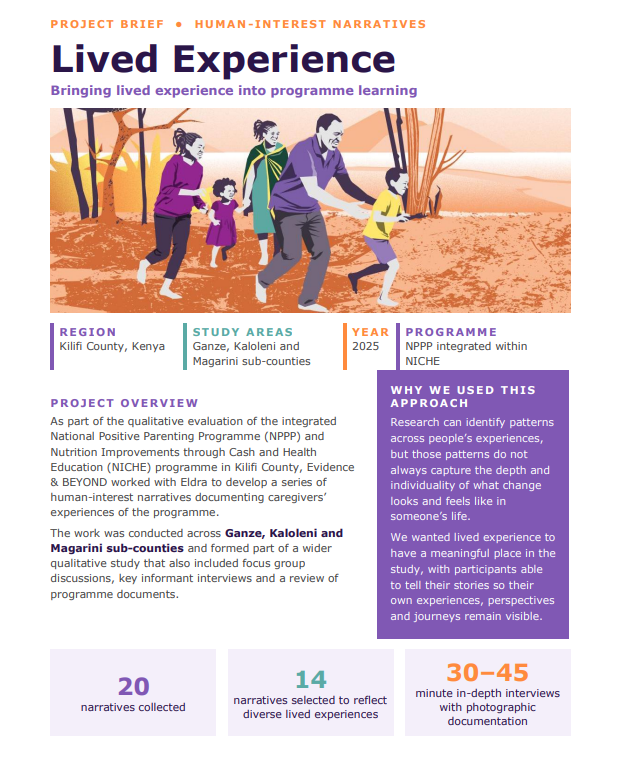
Working with Eldra consulting, we used human-interest storytelling alongside the wider qualitative evaluation to create a different way of hearing from caregivers about their experiences of the programme.
Dedicated follow-up interviews, ethical storytelling and photography were used to develop 14 narratives that kept individual experiences visible alongside the broader research findings.